EDCA may be represented as a parallel bidirectional, CA composition  where
where  is the “ground” CA, and
  is a set of cellular automata, each holding a spot.
Energy cellular automata  share the same cellular space of dimension d with
  , while energy expansion rule:
  , performs the function
  that evaluates expected energy coverage change for
  on each spot automaton. During EDCA evolution, cells in ground interact with spots in energy set
  through Energy Incidence Criterion
  . This interaction allows spots to enable cells transitions and make cells to cause spots switch sign and move to a new location, thus causing a ground CA to perform as an Asynchronous CA. Asynchronous update pattern
  is given by the Energy Incidence Criterion , where denotes the set of cells
  updated at time .
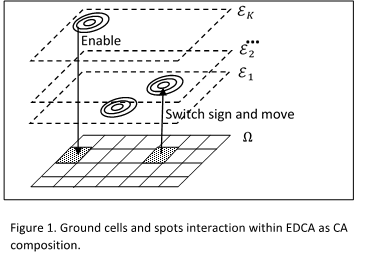
Transformation  , employed to find interacting cells and spots located on the ground and energy CA, assures the uniqueness of this solution and excludes ambiguities on the procedure of determining which cells are or aren’t enabled to change state, that is, a spot is allowed to interact with only one cell in order to contribute to its habilitation. This lack of contradictoriness guarantees the correctness of CA simulation process.
Composition approach to EDCA contributes to circumvent one of possible arguments that may be used to question its affiliation to the class of Cellular Automata, that is, the lack of strict locality on its interactions, as a cell may eventually spread its influence to an infinite zone on the cellular space, virtually “sending” a spot as far as possible. This problem may be solved having in mind that interactions inside each component CA (ground, and those conforming energy set) are strictly local, and inter-CA interaction occurs between cells having the same coordinates in cellular space.
 Energy Driven Cellular Automata