The rule M: s01234567/b8 is used to model a hypothetical “non-linear” electric conductor. Figure 1 shows part of EDCA modelling interface with “living” cells arranged in a row, imitating a conductor. The energy source, located near the left-most cell, provides energy spots that travel along the row. Spots are finally absorbed by the sink located at the right end of the row. Detailed configuration view shows that conductor is formed by 9-cell clusters, where only central cells may suffer changes according to the rule. Energy transport along the row is organized using these cells as follows:
- Source releases a positive spot which is absorbed by the first central cell to “revive”, thus releasing a negative spot. This energy is used by the neighbor located ahead along the row.
- Intermediate cells are arranged specially to transfer energy only to the right neighbor. For example, central cell A just got alive and released negative spot, but only right neighbor is ready to use released spot. Negative energy can’t go back because left central cell is “dead” and unable to absorb it. Similarly, cell B just died and released positive spot, which may only be absorbed by its right neighbor.
- This arrangement assures the one-direction current flow, which depends on the negative-positive spots releasing sequence.
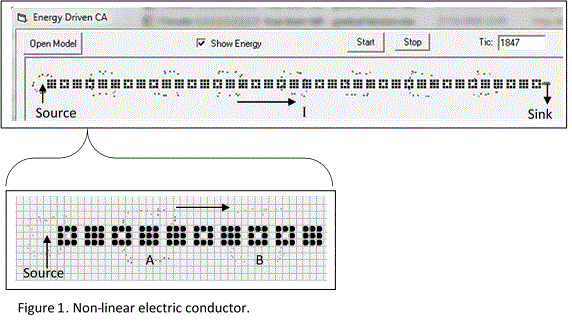
During the modeling operation, the source generator releases positive-negative spots pairs with monotone increasing rate. Characteristic electrical variables are obtained via statistical processing of data provided by energy-counting sensors, which monitor the model response to the received energy.
Source potential Us is taken from the number of spots released by the source. Sink potential Ud is given by the number of spots absorbed by the sink. Intensity of electric current (I) is modeled by the amount of spots passing through whole row, counting spots released by the right-most cell. Instant temperature of conductor (T) is estimated by counting cells transitions happened inside the line at given step.
Rates for Us, Ud and I are obtained by summing counted spots inside a moving time window of 450 steps.
Potential difference between source and sink, and conductor resistance:
U=Us, – Ud , R = U / I
Graphics provided in Figure 2 explain different aspects of the model activity. Evolving of potentials in time (Graphic A) suggests the partition of this activity into three clearly differentiated zones. Beginning from zone I, as the source potential increases, the potential difference U remains close to zero. This behavior is caused by the ordered transport of spots by the central cells: there is no “back travel” of energy, and all spots released by the source are absorbed by the sink. Graphics B, C and D show that the intensity also increases proportionally to Us, while temperature T is low and resistance R remains near zero.
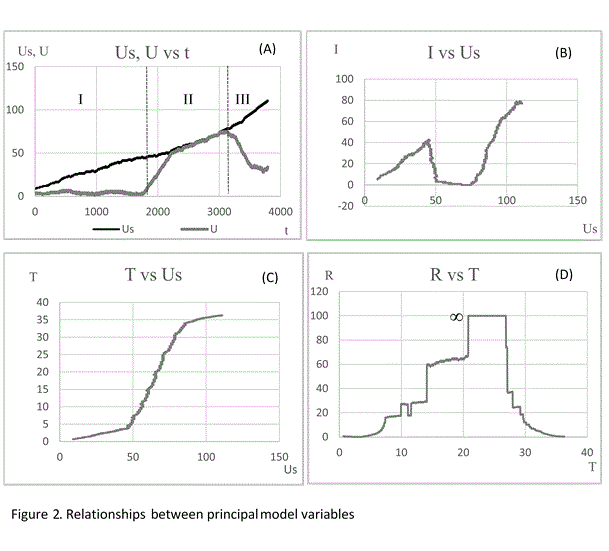
As Us continues stepping up (zone II), the spots emission rate becomes too high to be supported by organized transport. Each new spot comes to the first cell before it is ready to accept it. Energy is then absorbed by other cells ahead in the row, thus infringing established order and interrupting steady flow of energy. This zone is characterized by a sharp increase of the potential difference, as energy spots barely reach the sink.
Temperature also raises, because accumulated energy spots trigger a mounting number of disordered transitions in cells. The intensity of current drops to a value near zero and, consequently, the resistance of the conductor also sharply raises, even reaching infinite value at some steps (graphic B).
Zone III displays a considerable reestablishing of the current, as the source potential continues going up. Here the accumulation of energy spots continues, until they are pushed by “brute force” towards the sink by newly incoming spots. Potential difference drops again to a low value, but temperature remains high, reaching a new stable level. Graphic D (Resistance vs. Temperature) displays a highly non-linear dependence.
 Energy Driven Cellular Automata